Wednesday, February 10, 2010

Looks Like We Have A Fight!

WrestlingMatch

We have a match, folks!

Dr. Isis, that shining example of spousal devotion, maternal instinct, red-hot science, and beautiful shoes, will be in one corner. Facing off against her will be Marty Frank, Executive Director of the American Physiologic Society, science policy guru, and all-around nice guy.

[Please note photo is an artistic rendition and not the actual participants]

Here are their current statistics on Twitter:

@drisis first tweeted November 4, 2008. She has 977 followers and has posted 3069 updates.

@ExecDirectorAPS began twittering July 21, 2009. He has posted 329 updates for his 111 followers.

The challenge: sign up new Twitter followers (Tweeple or Tweeps) during Experimental Biology in Anaheim.

I will certify the number of followers each has at 7:59 am PDT on Friday, April 23, just before on-site registration opens at the meeting. When a predetermined deadline has been reached, I will once again check the number of followers for each. Whoever has the most new followers will win. For those of you more mathematically inclined:

New followers = N(deadline) – N(start)

I am letting the fighters determine the “prize” which may also determine the deadline. For example, if a tweet-up with the loser buying drinks is involved, we should probably end on Tuesday to allow that event to occur. If clown services at some point in the future are involved, well, we can go to the last minute on Wednesday.

Rules? Do we really need rules?

Yes, the goddess can pull off a lot of wackalunacy with her cloak of pseudonymity. Marty must maintain some degree of decorum, but he has the bully pulpit that comes with being a recognized authority figure, at least among APS members.

Will institutional power trump general hotness? Will stilettos kick sensible shoes? Who will win? Who will bleed?

Stay tuned for more!

Tuesday, February 9, 2010

Throwing the Gauntlet

EB2010Experimental Biology approaches, so shenanigans must be planned.

For this year’s meeting a tweet-off has been proposed:

Isis the Scientist, the hottest goddess of science, versus Marty Frank, Executive Director of the American Physiologic Society.

Isis sidebarVS. APS Logo

Goal: enroll the most new followers on twitter during the meeting.

As a reasonably neutral party who already follows both of these distinguished individuals on twitter, I volunteer to moderate the contest as follows:

  • Contest will begin at 0800 Pacific time on Friday, April 23, when on-site registration opens
  • Contest will end at 0800 Pacific time on Wednesday, April 28, so a winner can be determined before I have to head to the airport; we can move this back to noon on Tuesday if necessary for the “prize”
  • Shameless publicity stunts are not only permissible, but encouraged (especially if free drinks and/or public nudity are involved)
  • I will provide updates online and via twitter throughout the meeting; if APS allows, I may even post it on the whiteboard with the official registration numbers
  • The final “prize” will be negotiated by the participants; perhaps the loser buys at a tweet-up  or provides clown services at a party?

So, you two, are you up for it? Cause I’m ready for some game faces and trash-talking!

Monday, February 8, 2010

Super Game, but What Dat Ad?

SBLogoWho Dat winning the SuperBowl? In a really great game?

The Saints rocked Miami. The game entertained, and calling on onside kick to start the second half took gonads. Well done!

Was anyone else disappointed by the SuperBowl Ads?

My personal favorite was from Monster.com and involved a musically-inclined beaver.

Sorry I couldn’t get the video to embed correctly, so you will have to click the link above to see it.

Yes, the lucky little beaver gets a hot blonde in a hot tub as the ultimate success symbol. Sexist? Yes, but the whole ad was cute and funny and illustrative. This is one driven beaver, even though his career goals are different than those other rodents working on the dam. Monster.com is, after all, a career site, and this little guy got work, dam it. (Get it? Beaver, dam…)

Budweiser and Doritos both had some spots, and all were, well, OK. Nothing stellar, but… OK.

The ones that keep showing up that I just do not understand?

GoDaddy

Those from GoDaddy.com. They have paid money for Danica Patrick as their spokesperson. The ads feature her and other hot “I wannabe the GoDaddy girl” women in various states of undress. Click the icon if you want to see the TV ads or the less censored internet versions.

What do these ads have to do with anything? GoDaddy deals with internet domains. I realize that sex sells almost anything, but I keep looking at these spots thinking WTF? Are they only trying to register porn domains?

I guess Danica Patrick and a hot blonde masseuse in the spa do have some parallels with the Monster.com beaver and a hot blonde in a hottub. But the latter felt cute; the first one skanky.

FAIL GoDaddy. You need new marketing. Someone who is not a 13 year-old boy.

Friday, February 5, 2010

More Thoughts on HeLa

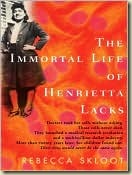
HeLaBook

I just completed The Immortal Life of Henrietta Lacks, by Rebecca Skloot. It is a must-read for a number of groups, including those who study cancer, those who use cultured cells, anyone who performs clinical research, and anyone in healthcare.

I read fast, but especially in this case. Many of my online peers had pre-release copies and have blogged about the book for weeks. I also wanted a review for the March issue of ASN Kidney News with its special section on kidney disease research issues.

Immortal Life addresses many issues relevant to medicine and life in the 20th century. Poverty and racism and access all influenced Henrietta’s (I feel like I’m on a first-name basis after reading her story) care and that of her children. As someone who works in basic science (and, for a couple of years, in a carcinogenesis laboratory), the history of tissue culture was fascinating. I learned far more about the development of human subject protection than I did from my required clinical research training, and in a far more memorable way.

Ms. Skloot’s time spent with Henrietta’s family paid off in the narrative in a big way. Henrietta is no longer just someone who died of cervical cancer; she becomes a beautiful, lively woman who dressed well and kept her finger- and toe-nails perfectly manicured in flaming red (a trait with which I can easily identify). Her story and those of her family, in particular her daughters, also drive home their mistrust of the medical and science professions.

The development of their mistrust of the biomedical enterprise brought me back to a book from last summer, Unscientific America. Mooney and Kirshenbaum argue that the public mistrusts scientists because we are, in general, so bad at communicating with them. Examples of bad communication abound in Immortal Life; even when supposedly getting “informed consent” for testing on Henrietta’s descendents, it is clear the family has no clue what will be done with their blood. When Deborah, Henrietta’s daughter, first visits a laboratory at Hopkins to find out what happens with her mother’s cells, the investigator gives her an autographed copy of a text he wrote on genetics, something she cannot fathom. (A second visit in the 21st century works out better and diffuses some of the concern and anger of the family members.)

I had a different argument after Unscientifc America, namely that scientists and other biomedical researchers had lost the public trust:

We were promised “better living through chemistry.” While DDT could zap mosquitoes and eliminate malaria, it had detrimental effects on the environment. The green revolution that has allowed the overpopulated world to be fed has taken its toll on the land. People now mistrust the agribusiness industry. In medicine, it seems like papers trumpet polar opposite results; the public can’t decide what to believe, and thus decides to believe no one.

Add to that perception experiences like those of the Lacks family, especially her daughter Elsie, and others of the time. More than a decade after Nuremburg researchers were still injecting people with cancer cells without telling them what they were. The Tuskegee syphilis experiments had just come to light. Today, when institutions have offices devoted to patents and business discovery development, patients donating tissues with appropriate informed consent want to know the value of their cells.

The Immortal Life of Henrietta Lacks reads like a novel but is absolutely true. It is must-reading for those involved in medicine or science, especially researchers working with human subjects (what a depersonalized term!). I believe it might help the general public as well, showing them the evolution of protection of their rights and dignity should they choose to participate in biomedical research.

This book could be a first step toward regaining some public trust.

And I swear I will not complain (at least not as much) the next time I have to answer all of those questions for our Institutional Review Board.

Happy Twitterversary!

At 21:20 CST today I will celebrate one year of tweeting.

twitter-logo When I enrolled, I could not comprehend the value of these short comments. Little did I know how twitter would become a part of my existence, complete with friends and colleagues who make me happy and sad and angry.

Until you try it, the whole concept sounds utterly ridiculous. What can you say in 140 characters, really? And how many people do you really reach?

At the time I write this, nearly 200 people follow my thoughts on twitter. If I tweet something particularly notable, my followers may retweet it, with the potential to reach thousands of tweeple in a manner of minutes. That impact is far broader and faster than an email chain.

I am now well over 2000 tweets. Some are interesting, many are drivel. But I have enjoyed them all.

Tuesday, February 2, 2010

Preventable? Death

This week a jury in Oregon deliberates the fate of the parents of Neil Beagley. Neil Neil died of complications of posterior urethral valves (PUV), a blockage of the male urinary tract. Last summer (2009), the parents of his niece were tried and convicted in her death from pneumonia and sepsis in infancy, with her father spending just under 2 months in jail for second-degree criminal mistreatment.

Why so many childhood deaths in this family? They belong to Followers of Christ, a group of approximately 2,000 in the Oregon City area who believe in healing by prayer and other spiritual means. Neil’s father and others in the group have been quoted in the press as saying going to the doctor shows a lack of faith. A large number of preventable childhood deaths led Oregon to modify its shield laws in 1999. These laws had previously allowed parents to use “spiritual healing” as a defense in the deaths of their children; the trial of Ava Worthington’s parents was the first test of these laws:

The Followers of Christ deaths prompted a firestorm in the 1999 state Legislature over religious freedom, parental rights and the state’s responsibility to protect children. After months of debate, legislators passed a compromise bill that emerged in the final days of the session and was quickly signed into law by Gov. John Kitzhaber.

The 1999 law eliminated Oregon’s “spiritual-healing defense” in cases of second-degree manslaughter, first- and second-degree criminal mistreatment and nonpayment of child support.

Pediatric nephrology in-the-news always catches my eye. The ethics of refusing care come up frequently in nephrology as well, even when chldren are the patients. I had to learn more about this case!

The Disease

PUV results in complete posteriorurethralvalves-fullblockage of the urinary tract (click on the diagram for a bigger version at the original website). It only occurs in males. The obstruction leads to dilatation of the bladder and ureters; urine may also reflux up the ureter rather than exiting the bladder during urination. The condition is most often diagnosed because of an abnormal prenatal ultrasound; after birth, a weak urinary stream, urinary tract infections, or protuberant bladder may lead to the diagnosis. Rarely, it is missed in infancy and the child presents with deterioration of kidney function.

Treatment first requires relieving the obstruction so urine can exit the body. Some boys may have mild renal dysfunction and do well; however, most will have some damage to the kidneys leading to kidney failure. Since chronic kidney disease has few symptoms before stage 3, monitoring growth and laboratory studies in these children is essential to prevent complications.

The Faith

Wikipedia provides a description of this religious group based in Oregon City, excerpted here:

The Oregon church was founded in the early 20th century by the Reverend Walter White, a "powerful, charismatic preacher" who led a congregation which broke away from a Kansas church of the same name in the 1940s.[2][3] White and his congregation moved to Oregon, and built a house of worship on Molalla Avenue in Oregon City, now a suburb of Portland. White died in 1969, and the church has functioned without a minister since then.[4] In addition to the denomination's Oregon City church building,

Estimates of the church's membership range from 1,200[4] to 2,300[5] A congregation of approximately 500 members is found in Caldwell, Idaho,[6] though the two churches have not been in communication with each other for about 40 years. The Oregon City church has secluded itself from all other churches that share its name.

The church is Pentecostal in origin, and believes in a literal interpretation of Scripture, including in the power of faith healing -- in the context of Pentecostal Christianity, the use of prayer and laying on of hands to cure illness.[3] Unlike many other churches which include faith healing as part of their doctrine, the Followers refuse all forms of medicine and professional medical care. The church practices shunning of those who violate or challenge church doctrine, including those who seek medical treatment; it has been alleged that many Followers clandestinely see doctors and dentists in defiance of church teaching[4]. The church is also known for legalism[7] and a male-dominated society.[4] 

Since the death of White, members of the church have increasingly isolated themselves from the community at large. The church no longer recruits or admits new members.[2] According to church members, children raised in the church attend public schools, but don't socialize outside the church once reaching middle-school age.[8]

Oregon health authorities first noted the church because of its infant mortality rate ~26 times that of the rest of the state. Investigation of deaths from the late 20th century led to the change in Oregon’s shield laws in 1999.

Because of its insularity and indoctrination, some have described this church as a cult.

The Boy

The older sisters of Neil, including the mother of Ava, attended public schools; however, Neil was home-schooled exclusively after third grade:

On the stand, the Beagleys offered stories of a son who once proclaimed that he didn't need to go to elementary school because he already knew everything.

Public school with its health requirements might have led to an earlier diagnosis; his short stature might have prompted concern among teachers.

He spent his afternoons working with his father in the business Neil hoped to own someday and working on a 1973 Camaro. He was very close to his father, a man who never visited a medical doctor unless it was required for work and who once told detectives that seeking medical care showed a "lack of faith." Neil spent time with his family and other relatives, all of whom are Followers of Christ. In short, this child had no contact with the world outside of this faith, other than social workers trying to avert unnecessary deaths of children within the community.

Other testimony noted his strong faith. Neil read his own bible faithfully, keeping it near while on his deathbed.

The Death

The prosecution describes this as an unnecessary death due to a treatable illness. The death of Ava was clearly tragic, since antibiotics could have cured her acute illness, leaving her to lead a long, healthy life. As a toddler, she had no input into the decision process. Is this as true of Neil?

Neil had a chronic disorder; the treatment of it would make him technology-dependent for life. He would receive dialysis until he got a successful kidney transplant or died. His life would require drugs and frequent medical visits. I have treated children with this disorder, and they lead complicated but worthwhile lives.

Neil never stood a chance.

The insular nature of his upbringing and the rigid beliefs of his parents would not have permitted him to be treated optimally. Had his parents permitted treatments they could be shunned by their community which was their life, their salvation. At the age of 16, Neil probably would not have followed a treatment plan himself, given his head-strong nature, religious beliefs, and lack of exposure to other viewpoints. Even if, somehow, treatment had been enforced, I suspect he would have stopped when he reached the age of majority. And that would have been his right.

Neil’s death could have been delayed a couple of years, but prevented? Probably not in the context of his culture and upbringing.

------------------------------------------------------------------------------

All of these are moot points, mere speculation on the part of someone with no direct knowledge of the community, the family, or the patient. Take them for what they are worth in that context.

Much of the information regarding the case was taken from stories at OregonLive.com, linked to in the text above.

Monday, February 1, 2010

Poken Fun!

Faithful readers know that my daughter is majoring in Communication with a focus on public relations. Friday she went to a conference, and mid-morning texted me from the social media session:

We need pokens! Google it, and order!

Really, it takes much less than that to get me shopping.

Pokens take the place of business cards (click here for great video explanations). These electonic gizmos, when you click the hands together, will exchange all electronic contact information and maintain a timeline function as well. So if you are trying to remember someone you met at a meeting 2 weeks ago, you can scroll back to that date to pull up their information.

Another cool feature: the poken information is updated every time the person in question updates it. So if I change my email address, my poken contacts automatically get the new one!

Of course, choosing a poken must be the hardest part:

PokenZooFunAfter much deliberation (accompanied by a fine Malbec blend from Chile), my offspring and I made our choices. She went with the dragon (It's hard tell if he's a good boy or bad boy. He's got the horns, but the smile, too.), while I purchased the pink alien (A recent addition to the Zoo's Area 54, we think she's a she), although it was a tough race with the green alien and voodoo pokens. 

They also sell less “cute” pokens:

PokenZooPulse

In addition to serving their poken function, they act as flash drives with up to 2GB of storage. The colored versions are sleek and cool, although all are black with just the poken 4-fingered hand to give them away when capped. The plain one can be custom branded as well.

I may get one of these plainer devices for my more “professional” online persona. My snarky “personal” online self will be the pink alien for now.

So snap a poken on your lanyard. It makes adding online friends and acquaintances easy. If you see me and my alien, let’s do the “high four" to exchange data!