Showing posts with label Hormones. Show all posts

Thursday, April 22, 2010

Paging the Page Kidney: Biomedical Musings

I recently saw a medical condition I had never encountered before. A teenager had been diagnosed several months ago with hypertension (high blood pressure) by his primary care physician. After dietary modifications failed to lower his readings to acceptable levels, an ultrasound showed an abnormality in one kidney. MRI further defined a mass within the kidney consistent with a resolving hematoma, or subcapsular bruise.

Irvine H. Page demonstrated that tightly wrapping a kidney with cellophane would induce hypertension in 1939; in his honor, this type of kidney problem is called a Page kidney. More information, including an MRI and pathologic specimen, can be seen in this feature in New England Journal of Medicine.

So how does wrapping a kidney in cellophane or adding a subcapsular mass cause high blood pressure?

Page Kidney

The left image shows a diagram of a normal kidney with its artery entering and branching. Repeated branches occur until each vessel ends in a filtering unit or glomerulus. The capsule forms the large border around the pink “meat” of the diagrammed kidney; this firmer scar-like structure holds the organ in place. If bleeding occurs within the kidney, from a blow to the flank or a kidney biopsy, a bruise may form under the capsule as in the image on the right. This bruise or hematoma cannot push the firmly made capsule out, so it squishes the working part of the kidney, including blood vessels in the region.

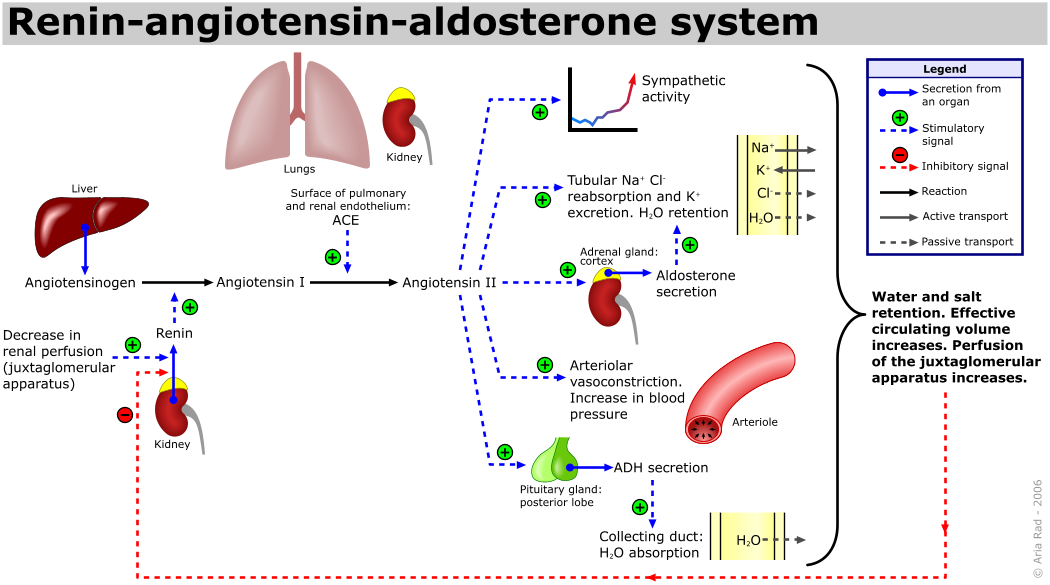
When the kidney sees a reduction in blood flow, it cannot tell if low blood pressure in the body or compression by a hematoma (or some wacky scientist wrapping it in cellophane) has caused the problem. The blood vessels near the glomeruli respond by pumping out a hormone called renin that turns on the angiotensin-aldosterone system, raising blood pressure throughout the body).

Thus, a squished kidney causes high blood pressure. This form of hypertension can often be cured by draining the hematoma or removing the offending kidney.

And 25 years after completing medical school, I still see new things!

Wednesday, September 23, 2009

Food For Thought

How do we get the message out that animals are important in biomedical research? There are so many things about normal cells and organs that we do not understand, and only through observing and testing in mice, rats, and other animals can we learn new things that can drive new treatments. A lot of animal testing could be redundant, and we can learn many things using cell and tissue cultures; however, on the sharp, cutting edge of science, interactions of various systems in a living organism are still necessary.

A while back when I was in medical school, physiologists studying animals could tell that some signal transmitted from the heart caused the kidneys to excrete sodium. My faculty were betting on some sort of neural signal. Instead, some investigators tried injected extract of heart into rodents and found that the atria of the heart produce a hormone that induces sodium excretion (see Experientia. 1982 Sep 15;38(9):1071-3). Eventually the secretory granules were identified, the protein was purified and named (atrial natriuretic peptide), the protein and gene were sequenced, and antibodies were made. We now know that other organs make these proteins (like brain), and we use them for diagnosis of heart problems (by measuring blood levels) and therapeutically (infusion of BNP can improve salt and water output in patients with congestive heart failure). It took about 20 years from initial discovery to clinical use, but this discovery has helped a lot of people and animals.

What other undiscovered systems lie in the living body? Computer models require that we know everything about a system so that we can predict its actions and reactions. I know we aren’t there yet. Culture studies cannot replicate complete living systems where multiple organs, tissues, and cells interact with each other. And we can’t examine some of these systems in humans because we do not have the technology to test them… yet.

Here is a video from the Foundation for Biomedical Research:

This short video tells a compelling story of living with a disease on all levels personal and professional; I am not certain it conveys how essential these rodents are to medical progress.

FBR has other stories planned. We will have to wait and see if the overall effect is what we need.

Sunday, August 16, 2009

Don’t Blame Estrogen

Over at Dr. Isis’ blog there has been much discussion about another blog on “civil argument” in the blogosphere. Isis took exception with some of the issues raised on another blog, and a commenter  to her blog suggested that the good goddess ECyclewas on the rag (OTR). She went on to apologize for her judgment being clouded by blood flowing from her vagina. She goes on to say:

“Then, just when I thought I had cleared enough of the estrogen from my girl brain to understand…”

As a female and a scientist who deals with the onset of puberty, I feel obliged to point out that estrogen cannot be the bad guy during menstruation. As shown in the diagram (which accompanies an article on faqs.org – click on the diagram to link there) estrogen levels are at their lowest during menstruation!

Estrogen rises steadily and peaks just before ovulation, with a secondary rise around day 21 when the body is thinking it might need to sustain a pregnancy. Progesterone has its big peak at that time as well. If pregnant, these hormones remain elevated; if not, they drop off and menstruation ensues.

If people want to ascribe behavioral issues associated with menstruation (AKA OTR syndrome), they cannot really blame female hormones. Perhaps it is the lack of these hormones, their withdrawl, that explains things. Perhaps it is cramps and having to carry around “protection.” Perhaps the men around us are jerks when they know they won’t get any. It is not estrogen mucking up a girly brain!

Perhaps men only see us as “logical” when estrogen peaks at ovulation and we are most likely to have sex… I will leave that exploration to another time.

I would like to point out that estrogen is a really important hormone in the central nervous system. One of the lessons we have learned from knocking-out its receptors in mice is that male neuroendocrine feedback in the brain is estrogen mediated. Seems testosterone is converted to estrogen which then signals in the brain of the male organism.

So the Big E is just as likely to be screwing up his brain as hers.