Showing posts with label Books. Show all posts

Wednesday, July 7, 2010

Half a Century Later

During my morning ablutions, I listened to my local NPR station per my usual routine (and yes, I am a member of KIOS).  Lynn Neary reported on the 50th anniversary of publication of a favorite book, To Kill A Mockingbird:
Fifty years ago, Harper Lee had the kind of success that most writers only dream about: Shortly after her novel, To Kill a Mockingbird, was published on July 11, 1960, it hit the best-seller lists. In 1961, it won a Pulitzer Prize, and in 1962, it was made into an Academy Award-winning film. It has never gone out of print.
Reading this book is a rite of passage for most adolescents in the US. Mary McDonagh Murphy interviewed writers, journalists, historians, and artists to collect their impressions in her book, Scout, Atticus & Boo. The NPR story also includes thoughts from students who recently read the book.TKAM

Many women identify with feisty Scout. My spouse sees Atticus,  especially in Gregory Peck’s movie portrayal, as the ideal father. In the NPR story, Joanne Gabbin, a professor of English at James Madison University in Virginia, saw her own father and grandfather mirrored in another character:
In Tom Robinson, the African-American man unjustly accused of rape, she saw not a victim, but a hero. He reminded her of her father and grandfather — African-American men who put up with untold humiliation in order to take care of their families.
To Kill A Mockingbird touches so many people in so many ways. For me, it illustrates the power of stories. Statistics may demonstrate racism or sexism or poverty other iniquities, but even with glitzy animated graphics they cannot enthrall us as plot and people do. Stories may be fictional, like To Kill A Mockingbird, or completely true, like The Immortal Life of Henrietta Lacks. In either of these cases, the way we come to know the characters and care about them (even if we hate them) helps the lessons stick.

Beautiful, poetic prose helps as well. NPR includes an excerpt from the book. My own favorite image arises when Scout describes grown ladies dealing with the heat of an Alabama summer. They add layers of talcum powder throughout the day, so by nightfall they resemble a frosted pastry. I am paraphrasing, but that picture embedded in my brain over 30 years ago. Every summer it flits through my neurons again during hot spells.

To Kill A Mockingbird hit bookstores a year before my birth. By the time I read it, much had changed in race relations and our attitudes toward mental illness. We still have progress ahead, since iniquities still plague the world.

But I have faith in the power of stories to help us mend our ways.
Click on the images above to see their source.

Saturday, May 15, 2010

What I'm Reading

A couple of weeks back, while at Experimental Biology, I saw Denialism displayed in the exhibit hall. I read the book jacket, whipped out my Kindle, and downloaded the book (immediate gratification). I did not start it immediately (delayed gratification), but I have now made my way about 3/4 through it.
Michael Specter examines many issues in modern society where belief trumps rational thought, including the anti-vaccination movement, genetically-modified foods, and dietary supplements. He presents the science, and the facts, as well as the viewpoints of the opposing side.
Unfortunately, many of the people who need to read this book will not. They do not seek facts or the truth; they believe what they want, and rational arguments will not sway them.
For the next few days I will be out and about with little time to blog. If you need to read something in my absence, buy Denialism.

Friday, February 5, 2010

More Thoughts on HeLa

HeLaBook

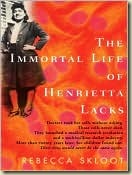
I just completed The Immortal Life of Henrietta Lacks, by Rebecca Skloot. It is a must-read for a number of groups, including those who study cancer, those who use cultured cells, anyone who performs clinical research, and anyone in healthcare.

I read fast, but especially in this case. Many of my online peers had pre-release copies and have blogged about the book for weeks. I also wanted a review for the March issue of ASN Kidney News with its special section on kidney disease research issues.

Immortal Life addresses many issues relevant to medicine and life in the 20th century. Poverty and racism and access all influenced Henrietta’s (I feel like I’m on a first-name basis after reading her story) care and that of her children. As someone who works in basic science (and, for a couple of years, in a carcinogenesis laboratory), the history of tissue culture was fascinating. I learned far more about the development of human subject protection than I did from my required clinical research training, and in a far more memorable way.

Ms. Skloot’s time spent with Henrietta’s family paid off in the narrative in a big way. Henrietta is no longer just someone who died of cervical cancer; she becomes a beautiful, lively woman who dressed well and kept her finger- and toe-nails perfectly manicured in flaming red (a trait with which I can easily identify). Her story and those of her family, in particular her daughters, also drive home their mistrust of the medical and science professions.

The development of their mistrust of the biomedical enterprise brought me back to a book from last summer, Unscientific America. Mooney and Kirshenbaum argue that the public mistrusts scientists because we are, in general, so bad at communicating with them. Examples of bad communication abound in Immortal Life; even when supposedly getting “informed consent” for testing on Henrietta’s descendents, it is clear the family has no clue what will be done with their blood. When Deborah, Henrietta’s daughter, first visits a laboratory at Hopkins to find out what happens with her mother’s cells, the investigator gives her an autographed copy of a text he wrote on genetics, something she cannot fathom. (A second visit in the 21st century works out better and diffuses some of the concern and anger of the family members.)

I had a different argument after Unscientifc America, namely that scientists and other biomedical researchers had lost the public trust:

We were promised “better living through chemistry.” While DDT could zap mosquitoes and eliminate malaria, it had detrimental effects on the environment. The green revolution that has allowed the overpopulated world to be fed has taken its toll on the land. People now mistrust the agribusiness industry. In medicine, it seems like papers trumpet polar opposite results; the public can’t decide what to believe, and thus decides to believe no one.

Add to that perception experiences like those of the Lacks family, especially her daughter Elsie, and others of the time. More than a decade after Nuremburg researchers were still injecting people with cancer cells without telling them what they were. The Tuskegee syphilis experiments had just come to light. Today, when institutions have offices devoted to patents and business discovery development, patients donating tissues with appropriate informed consent want to know the value of their cells.

The Immortal Life of Henrietta Lacks reads like a novel but is absolutely true. It is must-reading for those involved in medicine or science, especially researchers working with human subjects (what a depersonalized term!). I believe it might help the general public as well, showing them the evolution of protection of their rights and dignity should they choose to participate in biomedical research.

This book could be a first step toward regaining some public trust.

And I swear I will not complain (at least not as much) the next time I have to answer all of those questions for our Institutional Review Board.

Monday, January 11, 2010

“Don’t Be Such a Scientist:” Part Two

Last week I wrote about Randy Olson’s book Don’t Be Such a The girl the boxerScientist. Now that I have finished the read, I want to revisit Chapters 3 (Don’t be such a poor storyteller) and 4 (Don’t be so unlikeable). These chapters touch on current issues in the blogosphere.

In chapter 4, Olson expresses dismay about the foul language and intolerance displayed in evolution posts on ScienceBlogs:

The voice that came through in all of these blog posts, and even more intensely in the comments of fellow evolutionists, was not just offensive; it was also incredibly condescending and arrogant.

In this chapter, Olson concerns himself with likeability of scientists; in other words, maintaining civility within the discussion (a topic at SciOn later this week). He does have a point; people are unlikely to listen after you have called them fuckwits.

Unfortunately, a reasonable civil discussion violates chapter 3; let’s face it, conflict is essential for a good story.  People don’t pay to watch two guys glare and name-call in the ring; they want to see punches! Conflict sells and drives blog traffic (and income); the only way to make this bigger is to make it a nude-mud-wrestling grudge match (although I doubt most of the contributors on ScienceBlogs should be seen nude).

Let’s face it: some of those conflicts in commentary are damn entertaining! Virtual evisceration is sort of like “Shark Week” for readers, especially when you agree with the sharks! The danger, though, is that less aggressive species get scared off, leaving only those voices in complete agreement (see this post by Isis for more on this danger). You end up preaching to the choir (egads, a scientist uses a religious analogy), and you have to work even harder to generate conflict, leading to fights among the choir (this is why there are no longer any moderate republicans).

Unfortunately, I don’t have the solution to this problem (if I did, do you thing I would be plugging away on this post?). I try to stay civil on my little soapbox on the web, and I have to remain civil in ASN Kidney News, the magazine I edit. I do allow my inner snark to appear when I’m commenting on others’ sites.

Perhaps being a medical doctor is good training for this sort of conflict; if a teenager asks me about getting tattoos, I can say no, absolutely not, tattoos are stupid. Or I can talk to them about the safety issues surrounding the procedure, not to do it on the day they get hemodialysis and receive anticoagulation, and then discourage it (in med school I saw the effects of time and gravity on most tattoos, and it isn’t pretty). Most of the time, the latter approach has prevented or delayed the onset of tattooing without alienating my patient. Of course, the first scenario would make a much better story… especially if s/he gets the tattoo and returns to shoot up my clinic.

Photo courtesy of PhotoXpress.

Thursday, January 7, 2010

What I’m Reading (& EVERYONE Should Read)

A few years back EB featured a movie, Flock of Dodos.Dodos This film exploring the “debate” between evolution and intelligent design was captivating, educational, and entertaining. Its creator, Randy Olson, inspires me. A tenured professor, he left academia, attended film school at USC, and now makes movies about science.

Think Michael Moore with a PhD. In short, this is the career path of my dreams. That or writing the Great American Novel, developing the screenplay, and winning the Oscar for it. But I digress.

When I saw Olson’s book on communicating science, I had to read it immediately. Yesterday I read a review, downloaded it to my Kindle, and devoured about 40% of its virtual pages already.

Don’t Be Such a Scientist provides the answer to the real question facing science today!DontBe

A number of scientists with good communication skills kvetch about the public’s lack of literacy. Most seem focused on educational policy and getting “the facts” out there in an accessible way. If we provide the data, the public will “get it.”

Dr. Olson debunks this attitude almost immediately. Through amusing stories of his experiences in acting and film classes, as well as life under the Hollywood sign, he illustrates a major problem: most of the public engages in issues through feelings, not through thought, something similar to my prior post on the book Unscientific America:

Ultimately, two antithetical forces are at work here. Science demands testable facts to support its theories. Religion is based on faith which requires belief without proof. Having grown up in the bible belt, I can tell you that new earth creationists are not swayed by the fossil record or any other evidence you present regarding the reality of evolution. They believe.

Olson’s book discusses ways to relate to the public on this visceral level so they care about the science. Important issues need to be more visual and emotional; the opposite tactic that most scientific groups pursue!

It brought to mind several other books I have read dealing with science and exploration around the turn of the last century. Thunderstruck was the most recent of these, a story of the invention of wireless communication by Marconi intertwined with a murder mystery and transatlantic flight. What these books all had in common?

Scientists had to put on a show.

Federal funding for science? Just not there except for weapons in time of war. No, those who “discovered” stuff had to be independently wealthy or appeal to wealthy donors. Explorers and inventers would give demonstrations of their discoveries in hopes of acquiring funds for their next venture.

I am trying to imagine the last manuscript I read as a show. It would never make it to Broadway… As a movie, it would not even hit the direct to DVD market. On YouTube? Fuggedaboutit!

I have always acknowledged my creative streak, my desire to “put on a show.” Editing a magazine has been a much better fit than a journal, simply because we have to make it visually exciting (getting doctors and scientists to write for a magazine has been a bit of a challenge, but that’s another story). Olson’s book fits with my own, admittedly biased, viewpoint on the problem with science dissemination. If I didn’t have a grant to write (speaking of boring scientese), I would finish perusing the book right now.

By the way, Dr. Olson, I would love to work on a movie. Call me- we’ll do lunch (isn’t that the Hollywood way?).

Friday, December 18, 2009

A Universal Truth

Over at the temple of Isis, she used her experience shopping for empanada supplies to fuel a discussion of white privilege. Now, calling out asshats who do bad things to people of color, women, or other challenged groups is a good thing. That part did not catch my attention. Since reading the post, I have been thinking about tiny meat pies.

As the discussion proceeded, we acknowledged that evmeat-pie-4ozery culture has its own version of the empanada. The British have pasties. We eat wontons and potstickers. And what is a taco or burrito but seasoned meat in a crust? Online you can order cajun meat pies filled with beef (shown), crawfish, or a breakfast mixture of andouille sausage and eggs. Mix the meat into the batter and you have a dumpling.

Tiny meat pies are a universal truth, a common component of the human experience.

A few years back my daughter composed a report on Malaysia. She wanted to bring in food to go with her presentation. I scoured my Time-Life Foods of the World cookbooks and found this recipe. You can make the pastry from scratch, but refrigerated pie crusts do just fine.

The cookbooks were originally published in 1970 and revised in 1979, but are out of print at this time. Each country or region in the set included a wire-bound kitchen book with just recipes and a larger coffee-table style book with text about the culture and origins of the foods. Some photos are dated, but the set still provides a good culinary overview of the world. Used sets and books can be found  on Amazon.

I will share this recipe with you:

Malaysian Curry Puffs (~3 dozen puffs)

  • 6 fresh hot chilies, stemmed and seeded (don’t forget protective gear)
  • ~1-inch piece of fresh ginger root, scaped and coarsely chopped
  • 2 cloves gralic, peeled
  • 2 tablespoons butter
  • 2 tablespoons finely chopped onions
  • 1/2 lb lean ground beef
  • 1/2 teaspoon ground turmeric
  • 1/2 teaspoon ground cumin
  • 1/4 teaspoon ground coriander
  • 2 tablespoons strained fresh lime juice
  • Enough pie crust for 2-10-inch shells

Preheat oven to 375. Finely chop together the chilies, ginger, and garlic with a large knife or food processor.

In an 8- to 10-inch skillet, melt the butter over moderate heat. Saute the onions until soft and transparent, but not brown, ~3 minutes. Stir in the chilies, ginger, and garlic, and simmer for 2 to 3 more minutes. Then add the ground beef, breaking up any lumps. When no traces of pink remain in the meat, stir in the spices. Remove the pan from the heat.

On a lightly floured surface cut the crust into ~2.5-inch rounds. Put a scant teaspoon of the beef mixture in the center of a dough round. Moisten the edges with a finger dipped in water. Fold the round in half over the filling, then turn the ends toward each other into a crescent shape. Press the edges together with your finger or a fork.

Arrange the puffs on large ungreased baking sheets and bake for 25 to 30 minutes, until golden brown. May be served hot or at room temperature.

Friday, December 4, 2009

What I’m Reading

AmBITCHous

I have not addressed this topic for a while. I have been reading, but books  best described as mental marshmallow fluff. Not something worth putting pen to paper (pixel to screen?) about, really.

Last week I received a review of this new tome, and I had to check it out. Those who know me understand that I am a bitch, a woman who has goals and tries to achieve them. I believe we should embrace this term, rather than giving it the power to derail us.

I just finished the first part of am-BITCH-ous. Thus far Debra Condren, a psychologist and career coach, provides numerous anecdotes of women who gave up their own dreams to support those of their significant others and family members. For those of us living with these pressures, this section is repetitive and, at first, seems rather unnecessary. However, given the radical argument that Dr. Condren makes, it ultimately proves its value. What is that argument?

As professional women, we are being hoodwinked into believing that life-work balance is our dream.

I can hear you out there now. “But that is what I want- a great job with time for other things like my significant other, kids, hobbies, whatever.” The anecdotes provided illustrate how often women get shunted from a successful career to something else that seems more noble because it puts the needs of others first. And not just their needs; their desires and dreams and comfort. These women are applauded for putting the needs of others first, but they may later find out that they volunteered for the shaft.

Living with others, no matter how much you love them or what their relationship, requires compromises and hard choices. I realize that, and my family has negotiated such issues in the past. Never did I feel that I had to give up all of my dreams for my husband or children. I maybe didn’t get 100% of what I wanted, but I never felt like I got skunked.

It’s that time of year when stations start trotting out Frank Capra’s It’s a Wonderful Wonderful LifeLife. A few years back I heard this movie discussed by a psychiatrist  who really didn’t like its message. Yes, everyone loves George Bailey and bails him out at the end of the movie, but giving up one’s dreams and being so self-sacrificing is ultimately unhealthy. [I wish I could find the interview] Of course, this movie is FICTION. In real life, Mary Bailey would have been giving up her dreams of a career. Of course, all she wanted was George and a house full of kids…

Women who “make the correct choice” always seem to give up themselves for others. A few years of that would make one a desperate housewife…

I just now reached the meat of the book on how to avoid the trap. So far the exercises appear helpful, although I am guessing it will take a lot of work to get most women out of the martyr game. Especially since women are so applauded for successful martyrdom.

Sunday, November 8, 2009

What I Am Reading

I have been saving this one for a trip. A few years back my spouse LostSymbolhanded me a tattered paperback he had just finished- Angels and Demons. I took it to the airport, and I did not close my eyes until I finished it. The mix of history, symbolism, science, and some anti-papacy undertones kept me reading into the wee hours of the morning. I then devoured The Da Vinci Code, a much weaker book that still kept me turning pages. I have been waiting since then for Dan Brown’s next efforts.

If you liked the first two novels, The Lost Symbol will provide a lot of the same. Massive conspiracies that could end civilization as we know it all come together along with Robert Langdon. The Harvard Symbologist (can you really get a degree in that?) has less than 24 hours to decode a complex mystery to save his friends and the world as we know it. Substitute the Masons for various Roman Catholic groups… you get the picture.

Sometimes I pick up sequels because I want more of the same. The Lincoln Rhyme novels provide procedural murder mysteries with a familiar cast but novel twists in each one. The Lost Symbol is too much of the same.

However, I did enjoy one aspect of this novel immensely. When I was a freshman in high school, during the year of our bicentennial, I researched a year-long report on the signers of the Declaration of Independence. What struck me, growing up in the heart of the Bible Belt, was the lack of traditional religion among this group of men. Most were deists; a creator exists but has little to do with the day-to-day issues of human beings. They believed in intellectual curiosity and seeking answers to the way the world worked, that the creator wanted us to seek these answers for ourselves.

In Angels and Demons, one early scene in the book (not included in the movie for some inexplicable reason) sticks with me. The dead physicist-priest and his adopted daughter have been using particle physics to attempt to provide scientific proof of the existence of god (sound familiar?). This hot female yoga-master physicist demonstrates the interaction of a teensy bit of anti-matter with matter, resulting in a brilliant explosion. After witnessing this feat, Robert Langton utters, “My god!” The woman replies, “Exactly.” I loved this scene because it suggests that the creator is a source of energy and initiation, not some judgmental bearded guy on some heavenly throne. Much more believable than anything I have heard in church.

The Lost Symbol entertained me through a couple of airports and plane rides, but the plot was too familiar. Robert Langdon still appeals, and there are still symbols to unravel. Freshen something up next time, please.

Friday, October 16, 2009

What I'm Reading

It's been a while since I shared my pleasure reading. Last weekend I began The Crime Writer after my dad passed along a copy. It only took a couple of days to finish it, and I recommend it highly.

The protagonist, a successful crime novelist, awakens in a hospital room. He was found seizing, holding the knife that killed his ex-fiance, lying across her corpse. Ultimately found guilty of the crime, he is freed because of the benign brain tumor that could have induced temporary insanity, as well as the seizures.

He gets home, and has bizarre "dreams" complicated by unexplained injuries. To determine if he is sleepwalking, he sets up a webcam to record his sleep. This comes in handy the second night, when a young woman is found dead with injuries virtually identical to his ex-fiance.

He responds by doing that which he has always done: writing. As he assembles the story he is living, his research brings him to the real killer(s). Of course.

Mysteries enthrall me; I can't get enough of them, and I almost always uncover the key plot elements before the detective. This novel accomplished a rare feat: I did not figure out who the real killer(s) was/were until the same moment the protagonist did. That alone makes it an amazing read. The book is sprinkled with interesting facts and technical details, as well as one key plot twist, but it won't hurt your brain.

My patients have occupied me fully for the last 5 days, but I should find time to open something new this weekend. Keep on reading!

Friday, September 18, 2009

What I’m Reading

Angels Game

Sometime last year, a copy of The Shadow of the Wind, by Carlos Ruiz Zafon, came to me. For several days life was on hold while I perused its pages, enjoying the world it painted. If you have not read that one, STOP RIGHT NOW and get a copy. The story tells of the power of books, and reading the novel illustrates the power of books.

When I learned that The Angel’s Game would be available in translation, I was excited. Thus far, the tome does not disappoint. It starts with an orphaned child who has a gift of words and storytelling. He works as a gopher for a Barcelona newspaper, but is given the chance to write in 1917. He starts spinning tales of an underworld that captivates readers and leads to success. I am not yet a quarter through the book, but it already provides that mystical quality to events that makes me wonder what is reality and what might be magic. Once again, books have value and meaning beyond the printed word.

I am glad that my week of call finished a few minutes ago. While I have chores this weekend (Hello, laundry!) I hope to make major headway in the story. If events prevent its completion over the weekend, well, I have airport time next week!

Friday, August 28, 2009

Another Sad Farewell…

Rainbow

The senator from Massachusetts may be the top news story, but another sad passing has my attention. The last episode of Reading Rainbow airs today.

My kids moved out of its target audience years ago, but I was still depressed to learn that LeVar Burton would no longer lead children on adventures. No more children reviewing books. No more junior book club.

As reported on NPR this morning, the demise has been expected for several years:

the funding crunch is partially to blame, but the decision to end Reading Rainbow can also be traced to a shift in the philosophy of educational television programming. The change started with the Department of Education under the Bush administration, he explains, which wanted to see a much heavier focus on the basic tools of reading — like phonics and spelling.

John Grant (who is in charge of content at WNED Buffalo, Reading Rainbow's home station) says that PBS, CPB and the Department of Education put significant funding toward programming that would teach kids how to read — but that's not what Reading Rainbow was trying to do.

My daughter discovered this show shortly before her 4th birthday. Field trips and other diversions explored the themes suggested by the book of the episode. Nothing was off-limits; shows explored slavery and parents in prison, as well as animals and farms. Episodes often sent Jen and I traipsing to the library or Barnes & Noble, looking for a book we saw on the show or one with a similar theme.

No, this show was not about how to read; it was about the joy of reading, of losing yourself in another world. As John Grant noted in the NPR interview:

Reading Rainbow taught kids why to read," Grant says. "You know, the love of reading — [the show] encouraged kids to pick up a book and to read.

For many children educational television may support those first building blocks of reading- the alphabet and phonics on Sesame Street come to mind. Very few children’s shows encourage reading the way Rainbow did. Even though I had not turned it on in years, I am sad to know it will not be there for my grandchildren (not that I feel old enough to be a grandmother, even though it is biologically feasible at this time).

Guess I will just buy them books.

Rainbow courtesy of PhotoXpress.

Monday, August 10, 2009

Vacation in Missouri (and Paris and Britain)

TimBass

I have not posted in a week, as my family was visiting Lake of the Ozarks for a much needed period of fun-in-the-sun. My son is shown at left with one of the bass he caught & released (too small to become a meal).

During this time I have complete the fifth novel in the Aimee Leduc series that I last blogged about (What I’m Reading). My brain then went to Great Britain in the 1920’s with The Language of Bees by Laurie King. For those of you unfamiliar with the Mary Russell series, these sequels to the Sherlock Holmes series match the great detective with a brilliant younger woman who is in every way a match for his brilliance. I am now about half-way through another novel by David Liss, The Devil’s Company. This novel reprises Benjamin Weaver, a Jewish pugilist in England in the 1700’s who becomes a thieftaker, the equivalent of a private detective. This book seems quite timely since the hero finds himself blackmailed into infiltrating the East India Company. The Company is facing a new law that will make wearing their imported inexpensive Indian fabrics illegal in an effort to support local wool and silk industries. While set in the distant past, the debate seems so timely. Some things just never change.

My blog break must end now so that more catch-up work can be pursued. No vacation goes unpunished…

Sunday, August 2, 2009

What I’m Reading

MurderBastille

I have worked every day this past week, but my brain has been in Paris… still. I am now reading Murder in the Bastille, the fourth book by Cara Black featuring detective Aimee Leduc.

This time the detective tries to do a good deed when the woman at the next table in a restaurant leaves her cell phone behind. Aimee answers it, and a man begs her to meet him in a passage in the Bastille neighborhood. Remembering what a pain a lost cell phone was, Aimee treks off to return the device, and gets her head bashed in for her efforts. She awakens in the hospital blind; the other woman’s body is found the next day one passage over.

The tables are now turned for she and her partner, Rene, a programmer, student of the martial arts, and little person (dwarf). As the more mobile of the pair, Rene now finds himself interviewing contacts from the dead woman’s phone and attempting to piece together the clues. The scene where he ends up in a dermatology institute to speak with a pathologist is priceless! Aimee is trying to cope with her loss while her attacker tries to finish her off. Of course, she still wears Chanel lipstick and stumbles across potential male companionship along the way!

Book five is already on my iPod’s Kindle reader, and I am going on vacation next week. I may not be posting much, but I will be enjoying a few good books… You should, too!

Friday, July 31, 2009

Boomsday, Redux

This morning I heard a startling news item on NPR:

For example, this moment, during President Obama's town meeting yesterday, the meeting was hosted by AARP, and at one point a caller named Mary put this question to the president about something that she had heard is in the House bill.


MARY: I have been told there is a clause in there that everyone that's Medicare age will be visited and told to decide how they wish to die. This bothers me greatly, and I'd like for you to promise me that this is not in this bill.

I knew this was another case of fiction becoming reality!Boomsday-cover

Last year, Christopher Buckley’s novel Boomsday kept me entertained through a flight somewhere and well into the night after arrival (this explains my drowsiness the next morning). The title refers to the date when the majority of baby boomers retire, precipitating an economic catastrophe for the country.

The heroine is Cassandra Devine, a savvy 29-year-old PR professional working in an agency run by one of the guys from Thank You for Smoking, an earlier Buckley work. She writes a popular blog (a la Dr. Isis), and she inspires her readers to storm golf courses and gated communities to terrorize the Medicare set. One late night she develops a concept of “voluntary transitioning” for boomers; in other words, they get some benefits (free Botox? reduced inheritance taxes?) if they agree to kick the bucket at age 70. Yup, it’s voluntary suicide. She repeatedly tells people that this is a “meta-issue” meant solely to drive the conversation and get the economic mess fixed, but like many ideas, this one develops a life of its own and is soon out of her control.

Unfortunately, this book has one thing completely in common with reality: tough choices don’t get made.

I won’t tell you any more about the book, because you really ought to read it yourself. Hell, you should buy it and help out Mr. Buckley who lost his job at the National Review (founded by his dad) because he endorsed Barak Obama for president!

The truth is no one really wants retirees to “pick their method of death:”

Mr. DAU: The House bill includes a provision that would allow Medicare to pay doctors for taking the time to talk with their patients about the very difficult choices that people face at the end of their life about health care: What kind of interventions you might want in the case of a bad accident or debilitating illness. It would empower individuals to make the best possible health care choices for them and their families and allow doctors to provide their patients with this so that no one's guessing at the end of a person's life.


SIEGEL: Because you're saying that that consultation that the doctor would offer or another health care professional might offer would, under the bill, now become covered by Medicare.

Thus far the debate on health care reform is a mess, driven more by fear than fact. I truly hope that our government can get it together and cover all of our citizens.

In the meantime, I’m waiting for Christopher Buckley to write another book!

Monday, July 27, 2009

The Contents of My Bag

I have now progressed to the third Aimee Leduc mystery, Murder in the Sentier. Below is one of my favorite passages thus far that will illustrate the pull these stories have for me. She has been out on a Vespa chasing crime when she has to enter an upscale venue. Aimee is always prepared:

"A block away, she entered a deserted courtyard, set down her backpack, and got to work. She stood on the cobbles, reapplying her Chanel-red lipstick in a window. Looking in a tall truck's side-view mirror, she reapplied mascara. She flattened her spiky hair with gel, then slid into the heels she carried, along with a new cryptography manual, calcium biscuits for Miles Davis [her dog, pronounced Meels Dahvees], and black silk underwear crushed at the bottom of her bag.

One never knew."
Her bag contents always include Chanel lipstick, ultrablack mascara, and high heels (unless she is wearing heels or boots, and then her red high-tops are there). And black silk underwear, because you just never know what might happen.

I wish I were that prepared for my life.

My bag contents:
Wallet and keys
Assorted lipsticks and glosses
Toothbrush and stuff for my braces
Hospital IDs
Chargers for BlackBerry & iPod
Earphones for iPod
Pens in various states of usability
BlackBerry & iPod

Given the size of the bag I carry, this seems pitiful. I certainly couldn't make myself ready for a hot club with my present contents, let alone chase bad guys and make the world a safer place.

But then, I don't have to!

Sunday, July 26, 2009

What I’m Reading

Murder Marais

My father loves France. His PhD is in French history, and I am named after an actress (Pascale Petit) he saw in the 1950’s while working on his dissertation in that country. He is also a murder mystery fan(like me), so Cara Black’s series set in present day Paris appealed to him. He has been after me to read one for months, so I loaded up a couple for my latest trip.

Murder in the Marais, the first book in the Aimee Leduc mysteries, involves present day murders as well as crimes during the Nazi occupation. The heroine has limited herself to computer investigations since her father’s death by terrorism, but impending financial difficulties and curiosity push her back undercover to infiltrate a skinhead group. Eventually she uncovers not only the original crimes during the war, but also ongoing conspiracies that threaten Europe in the present.

I have never been to Paris, so I cannot comment on the authenticity of the prose; however, there are enough references to designer clothes and upscale venues (and hot sex) to satisfy a chick-lit craving. I’ve already got the second book on deck…

Friday, July 24, 2009

How I’m Wired

I just read a column about how anyone who is cool has an iPhone. Now, as a 48-year-old woman, I doubt that I meet the definition of “cool” in any way. However, I am as wired (or more so) than my 16- and 21-year-old offspring!

My workhorse is a year-old BlackBerry Pearl (I would picture it here, but I can’t take a picture of it with it so…). It works seamlessly with the BlackBerry server at my work, keeps me up to date with FaceBook and Twitter (seriously, if you don’t have UberTwitter, download it NOW), and runs the clinical software for one of my hospitals. I have tweaked available apps to do my patient billing, I get weather and real-time sports updates, and I can carry around photos of my kids, pets, and husband. I would like to be able to double its memory, and there are downsides to the compressed keyboard, but I love the little gizmo.

What my Pearl could not do was read Kindle files. It’s screen was pretty small for reading anyway. And I have a netbook I can use for documents. Why did I need another e-toy?

IMG00104

Then my boss showed me the Kindle app on his iPhone. The screen is big enough to read clearly, and an iPod Touch is at least $100 less than a Kindle. My old iPod’s battery was only lasting about 20 minutes, and I just got a $200 honorarium. The stars were aligned for the purchase of the bad boy at right, now wrapped in a purple silicone case.

I downloaded a bunch of books, and some “fun” apps (none of which cost more than $2.99). I then packed my bags and took off for a 4-day business meeting.

The Kindle reader is a blessing. I became aware of a book I wanted to read soon immediately, so I downloaded via the hotel’s lobby hotspot. In a package smaller than a paperback I brought 3 novels along. And I can listen to music while I read.

I have found some games I like, but most of the apps available don’t appeal to me. That’s OK, I am not their target market. I don’t need iBeer to feel cool; I can buy real beer when I want to feel cool! Web sites are easier to read on the bigger screen, though, especially in landscape format.

I still prefer an actual keyboard to the on-screen version. Even with the compressed one on the Pearl, I’m a fairly fast thumb-typist. With the iPod Touch, I am reduced to one-finger work with lots of errors, even in landscape mode. Way slower, for me, than the Pearl interface.

For right now, I am OK with two devices. Together they take up less space than my first cell phone! I don’t have enough memory on a BlackBerry to ditch my iPod, and it’s screen is too small for ebooks. My weeks with the Touch confirms the keyboard difficulties I experienced in the store when the iPhone debuted. Besides, there are apps for work that I just can’t do with an iPhone!

I am due for a new device about the time the BlackBerry Magnum is supposed to debut. Now there’s a cool device for a hot, middle-aged babe like me!

Monday, July 20, 2009

More Questions Than Answers

I wrote my weekly “What I’m Reading” post and scheduled it to publish on Sunday… July 26. The bad news: I wanted to push it out there on July 19. The good news: there will definitely be a post this coming Sunday since I can’t figure out how to reschedule its publication date!

UnsciAmI follow a number of bloggers on ScienceBlogs. Recently a tidal wave of “discussion” about Unscientific America has left me dismayed by the lack of civility and the comments by people who haven’t read the book.

I downloaded the tome to my new iPod Touch with Kindle reader, and whipped through it in a day. My reaction overall is mixed. I do not see the problem as a lack of science literacy (has the general public ever really understood much about science? Or history? Or literature?) No, I see a lack of respect for science and scientists as the real issue. We need to regain public trust!

Adding communication classes to PhD work seems unlikely to solve the problem of a lack of respect for science. As much as I loved the work of Carl Sagan, having his clone about today would probably do little to reassure the general public. We were promised “better living through chemistry.” While DDT could zap mosquitoes and eliminate malaria, it had detrimental effects on the environment. The green revolution that has allowed the overpopulated world to be fed has taken its toll on the land. People now mistrust the agribusiness industry. In medicine, it seems like papers trumpet polar opposite results; the public can’t decide what to believe, and thus decides to believe no one.

The major complaint about the book over on ScienceBlogs regards religion. Mooney and Kirshenbaum take PZ Myers (Pharyngula) to task for “crackergate.” I have only been hanging out in the blogosphere for about 6 months, so I missed the original escapade. Basically, PZ, an atheist, showed photos of a defiled communion wafer on the blog a few years back. I remember hearing a bit about this in the mainstream media at the time. My reaction: (1) I guess he really wanted to piss people off; and (2) don’t the people whining about his “blasphemy” have something bigger to worry about? The chapter also discusses others in the blogosphere who are referred to as “the new atheists,” an in-your-face breed of nonbelievers. I have to agree with the contention that aggressive atheists turn off the holy rollers, especially when their faith is mocked. That is not the way to earn their respect; however, even if Carl Sagan came back from the dead to poetically tell them that the beliefs of their faith (creationism, etc) are wrong, it is unlikely that they will budge.

Ultimately, two antithetical forces are at work here. Science demands testable facts to support its theories. Religion is based on faith which requires belief without proof. Having grown up in the bible belt, I can tell you that new earth creationists are not swayed by the fossil record or any other evidence you present regarding the reality of evolution. They believe.

The book raised some interesting points and gave me things to think about on the airplane. It’s a good starting point for the discussion on attitudes toward science in the US, but I don’t believe it provides the complete answer we seek.

Sunday, July 12, 2009

What I’m Reading

About Face

The Whiskey Rebels was a great read. Now I’m back to the present era, but in a different country. My father, also a mystery reader, has lent me his Kindle so I can partake of the newest from Donna Leon, About Face.

This book features Commissario Guido Brunetti, a detective in the Venetian police. The series involves regular murders and crimes, not serial killers leaving trails of tortured victims. Brunetti has a boss who is more politician than crime-fighter, but the secretary to the boss, Signorina Elettra, is a beautiful, stylish, and idealistic computer nerd who can find almost any information needed to solve a crime. She can also work the Vice-Questore to get what she and her comrades need to solve each crime.

The books paint a beautiful, yet disturbing, portrait of life in Venice. Brunetti is married to the daughter of a wealthy count; of course, she is a communist who teaches literature and loves Henry James. They have two children who have grown up through the series. Leon details daily life in Venice, from morning espresso to after-dinner grappa. The disturbing part involves the corruption of Italian society and government. Bribery and abuse of power seem to figure in many stories, and may prevent the truth from surfacing.

I am only a couple of chapters into the present book, but the detailed characters have already drawn me back into the Commissario’s world. Once again, I will post an after-read review on my LinkedIn reading list. In the meantime, I highly recommend this series to anyone who likes mysteries.